
EMS revenue-cycle specialists tracing a claim through operational source data

Billing & Revenue Cycle

Find documentation risk before it becomes preventable revenue loss.

Connect billing and clearinghouse outcomes with clinical documentation, CAD times and mileage, payer patterns and correction work to show where revenue is delayed, denied or leaking.

Billing + clinicalSource-to-claim context
CorrectionOwner and ageing
RevenueDenials, A/R and leakage
Data brought together
Billing & clearinghouseePCR & clinicalCAD times & mileagePayers & facilitiesProvider correctionsPayment outcomes

Purpose-built capability

A focused workspace for Billing & Revenue Cycle

Designed around actionable exceptions, visible evidence, role boundaries and accountable follow-through.

01

Billing readiness

Check signatures, demographics, payer details, timestamps, destination, procedure and medication documentation, narrative sufficiency and internal consistency.

  • Readiness checklist
  • Hold-billing queue
  • Medical-necessity support
  • Source-linked rationale
02

Correction workflow

Send a specific deficiency to the provider, supervisor, coder or billing team with a due date and complete response history.

  • Assigned correction
  • Ageing and escalation
  • Resubmission
  • Reviewer acceptance
03

Revenue & service-line intelligence

Analyze claims, denials, payments, unbilled encounters and correction cycle time—and, where authoritative cost and utilization data are connected, relate revenue to service-line performance.

  • Revenue leakage
  • Payer and transport trends
  • Service-line context
  • Period comparison
04

Vendor oversight

Reconcile incidents and clinical records to claims, denials and payments so agencies can independently measure outsourced billing performance.

  • Source-to-claim reconciliation
  • A/R and collection KPIs
  • Exception audit
  • Least-necessary PHI

Product interface

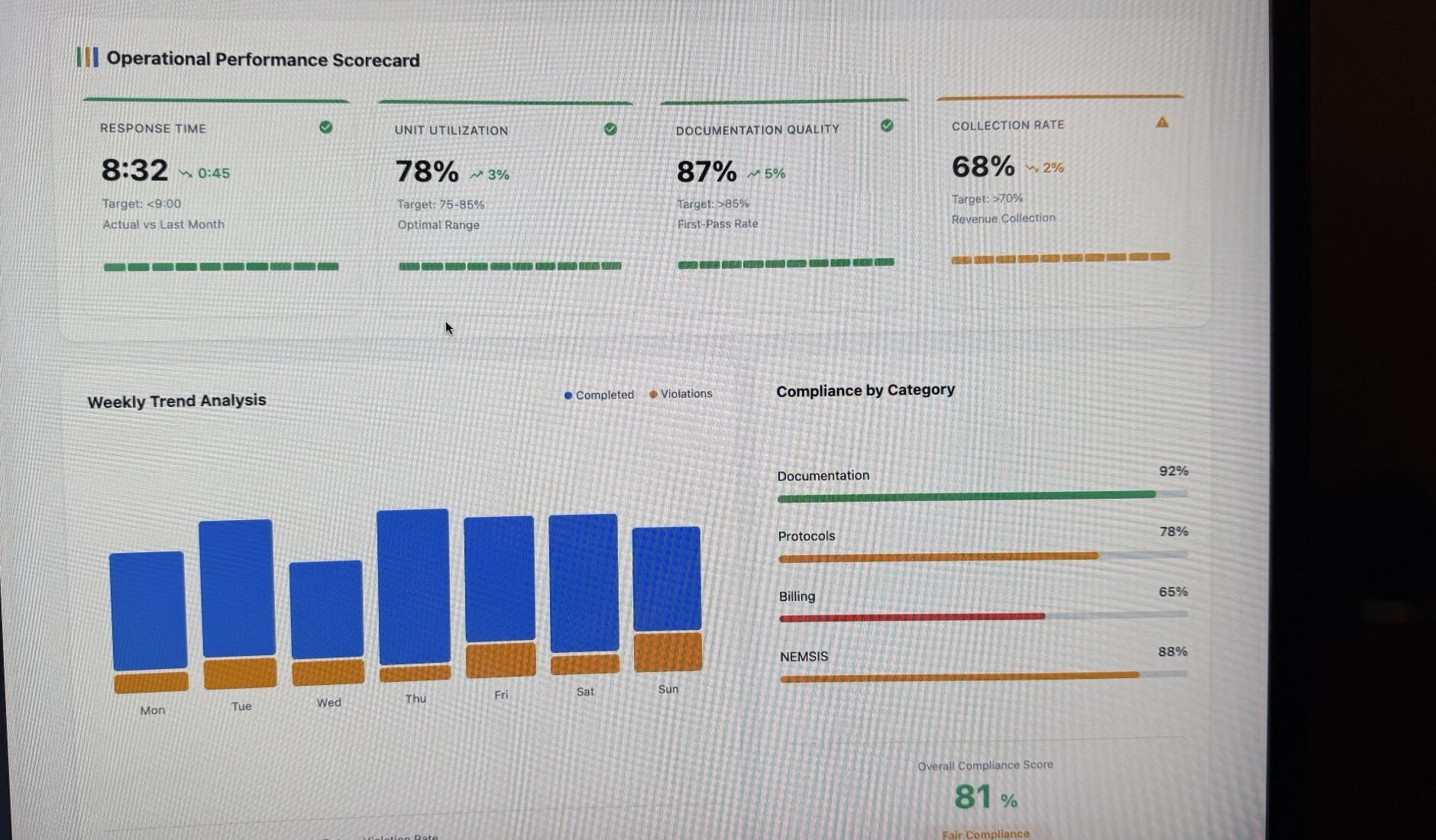
Revenue and documentation measures appear alongside the operational context that created them.

Focused role views bring source evidence, operational context and action together without forcing teams to interpret disconnected reports.

GAGE
Operational scorecard with documentation and collection measures

Revenue workbench

Fix the chart, document the handoff, measure the outcome.

Illustrative GAGE workspace
88%Billing ready
31Correction holds
1.8 dCycle time
14Unbilled candidates
Priority workspaceOwner · Status · Evidence

Missing signature — provider assigned

Review

Narrative does not support transport level — review

Open

Failed export — billing owner notified

Review

Denial theme — documentation pattern identified

Open
01 Evidence stays attached to the signal.02 The accountable role sees the action it owns.03 Status and closure remain visible across departments.

Why it stands apart

Revenue performance connected to the operation that created it.

GAGE traces revenue outcomes across incident, documentation, transport and billing data. It does not upcode, guarantee reimbursement or invent unsupported clinical facts.

  • Cross-system reconciliation
  • Traceable to source
  • Correction accountability
  • Vendor performance visibility

Coming Soon

The next capabilities for this workspace

These integration-dependent and longer-horizon functions will be released after their source data, controls and validation are ready.

On the horizon

Claim submission and remittance automation

Bidirectional claim submission, status and payment workflows beyond the supported billing and clearinghouse feeds available at launch.

Build a clearer operating picture

See how GAGE can connect and analyze the data your agency already produces across its operational systems.

Request a demo